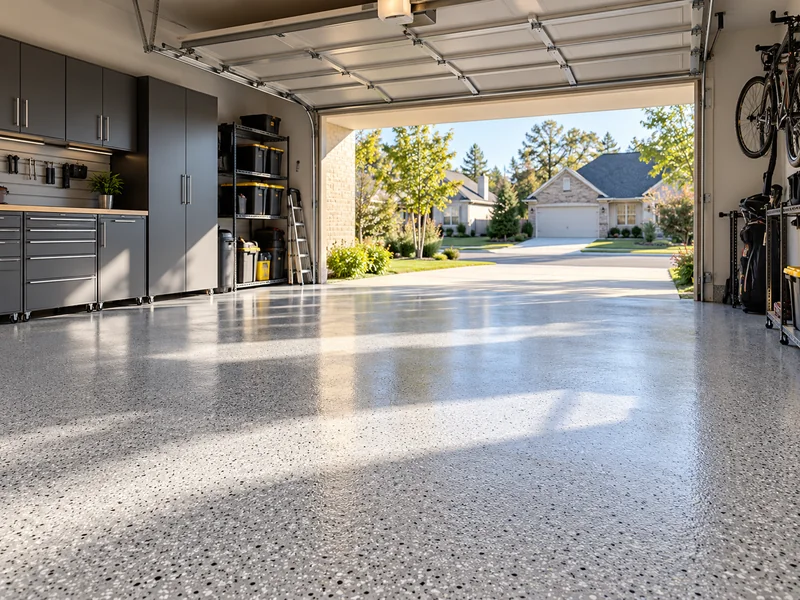
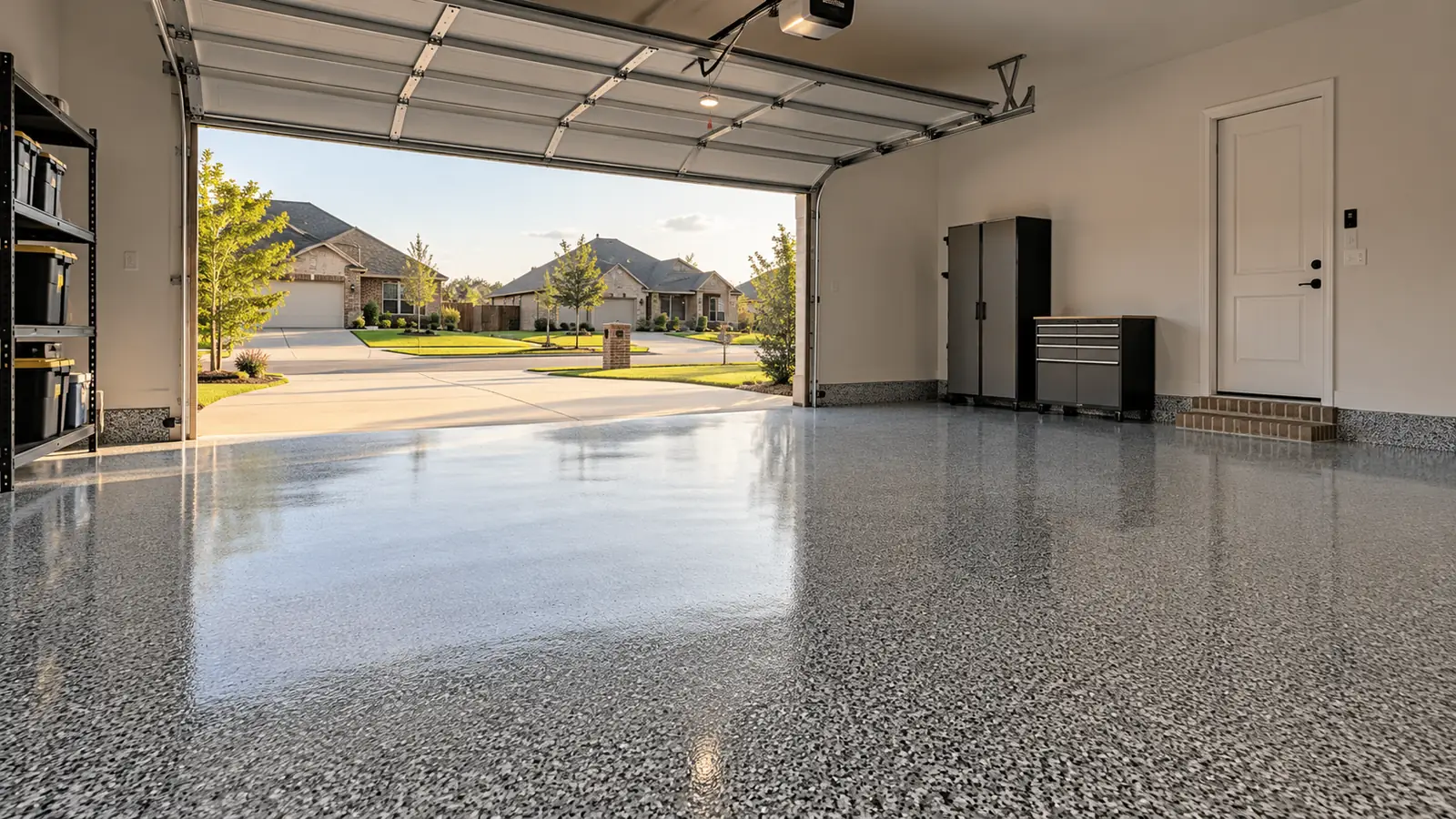
Flake epoxy garage floor in an Edmond home

Edmond Epoxy Flooring: Garage floor epoxy, polyaspartic coatings and commercial epoxy floors in Edmond, OK

Edmond Epoxy Flooring installs epoxy flooring and garage floor coatings for homes and businesses in Edmond, OK. If your concrete is stained with oil, pitted, dusting or cracked, an epoxy floor coating seals it under a hard, seamless surface that resists hot tire pickup, chemicals and daily wear.

Prep is what makes a coating last. Every floor starts with diamond grinding, crack repair and moisture testing, because skipped prep is the most common reason epoxy floors peel. From there, we install 100% solids epoxy, polyaspartic and polyurea systems in flake, metallic, quartz and solid color finishes, whether it's a two-car garage off Covell Road, a patio in Oak Tree or a warehouse floor near I-35.

Ready to start your epoxy flooring project? Call or fill out the form for a free estimate.

Call (405) 938-0946

Get a free estimate

Tell us about your floor and we'll follow up to schedule a free on-site estimate.

We use your details only to respond about your flooring project.

Thanks — we got your request and will be in touch shortly.

Garage floor epoxy and coatings

Your garage floor takes more abuse than any other slab in the house: hot tires, oil, road grime and Oklahoma's temperature swings. A garage floor coating protects it and makes it easy to clean.

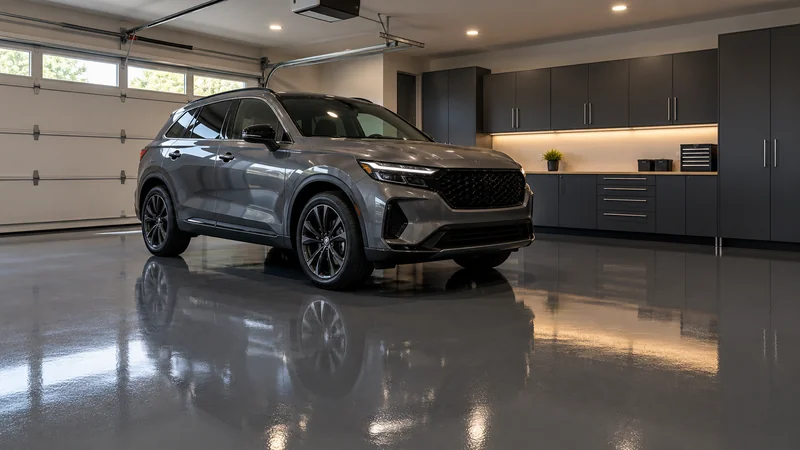
Glossy gray epoxy garage floor with an SUV parked on it

Epoxy garage floor coating

An epoxy garage floor coating is a layered system: a base coat bonded to diamond-ground concrete, an optional broadcast of color flakes and a clear topcoat. The finished epoxy garage floor resists oil stains, hot tire pickup and concrete dusting. Professional 100% solids epoxy builds a much thicker film than the water-based epoxy in DIY kits, and typically lasts 10 to 20 years versus 3 to 5.
Garage floor painting vs. a professional coating

Many people searching for garage floor painting actually want a coating. Garage floor paint, including one-part epoxy paint, is a thin film that sits on top of the concrete and often lifts under hot tires within a year or two. A professional coating is a two-part system bonded to ground concrete.

FeatureGarage floor paintProfessional epoxy coating
Typical lifespan1–2 years10–20 years
BondSits on the surfaceBonds to ground concrete
Hot tire resistanceLowHigh
Surface prepCleaning or etchingDiamond grinding and crack repair
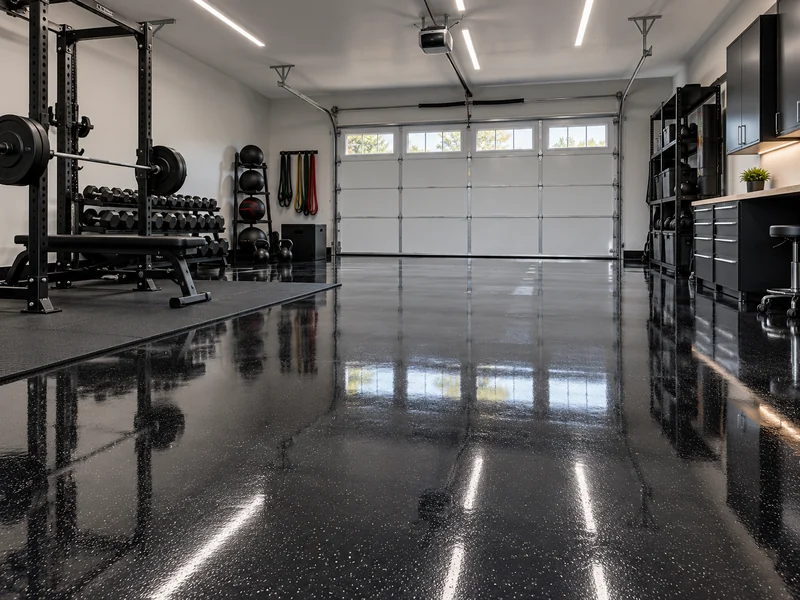
Dark flake epoxy garage floor in a home gym

Epoxy garage floor colors

Garage floor epoxy colors fall into four groups: solid colors (gray, tan, charcoal and black), flake blends, metallics, and clear coats over stained concrete. Flake blends are the most popular choice because they hide tire marks, dust and small imperfections. Black epoxy garage floors and metallics have a showroom look but show dust more readily.

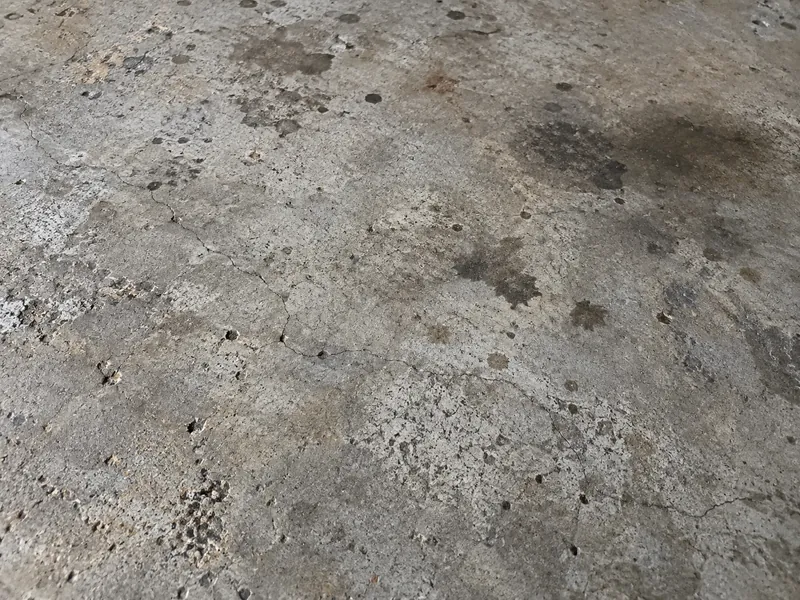
Stained, pitted concrete garage floor before resurfacing

Garage floor resurfacing and repair

Older garage floors often have hairline cracks, pitting or spalling from freeze-thaw cycles. We fill cracks with epoxy or polyurea filler, patch spalled areas and grind high spots before coating, so garage floor resurfacing and the new coating happen in one project instead of a slab replacement. Worn epoxy floors can be ground and recoated the same way.

Polyaspartic and polyurea floor coatings

Polyaspartic and polyurea floor coatings cure in hours instead of days, stay flexible and won't yellow in sunlight.

Gray flake polyaspartic garage floor in direct sunlight

Polyaspartic garage floor coating

A polyaspartic garage floor coating can often be installed in a single day, with foot traffic in a few hours and vehicles back on it within 24 to 48 hours. It's UV-stable, so it won't amber near an open garage door, and it resists hot tire pickup. Polyaspartic also cures across a wider temperature range than epoxy, which helps during an Oklahoma August or January.

Polyurea floor coating

A polyurea floor coating is often used as a flexible base coat under a polyaspartic topcoat. That flexibility absorbs impacts and minor slab movement that can crack a rigid epoxy finish, and a polyurea garage floor coating system is one of the fastest-curing options available.

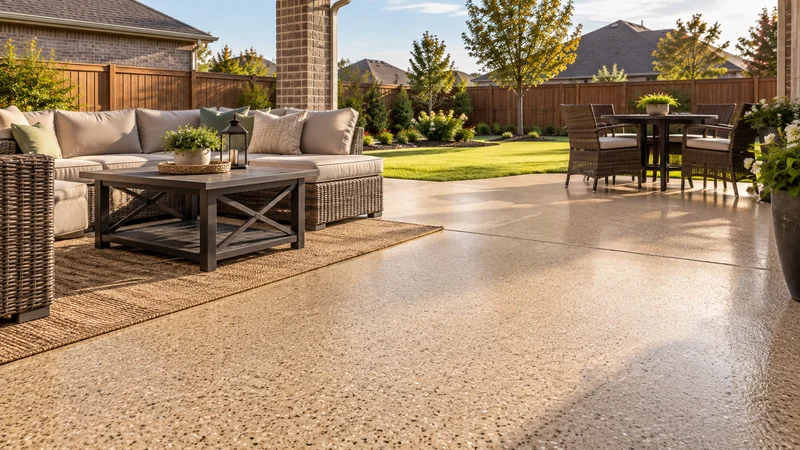
Polyaspartic floor coating on a backyard patio

Polyaspartic driveway and patio coatings

Standard epoxy chalks and yellows outdoors, so driveways and patios get UV-stable polyaspartic or polyurea coatings instead. They resist oil drips and hot tires, seal out the water that drives freeze-thaw damage, and can include a non-slip aggregate for wet areas.

Decorative epoxy floor finishes

Every coating system above can be finished to look like stone, metal or a clean solid color.

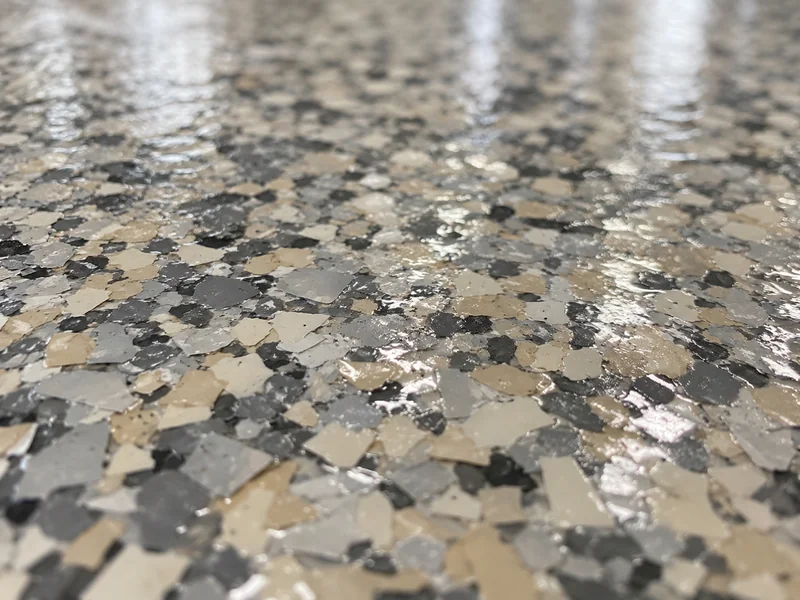
Close-up of a gray and tan flake epoxy floor

Flake epoxy floors

Flake epoxy floors, also called chip floors, have vinyl color flakes broadcast into the base coat and sealed under a clear topcoat. Blends range from single-tone to granite-like mixes. The texture adds slip resistance and hides dirt and minor imperfections, which is why flake is the most common finish for epoxy garage floors.

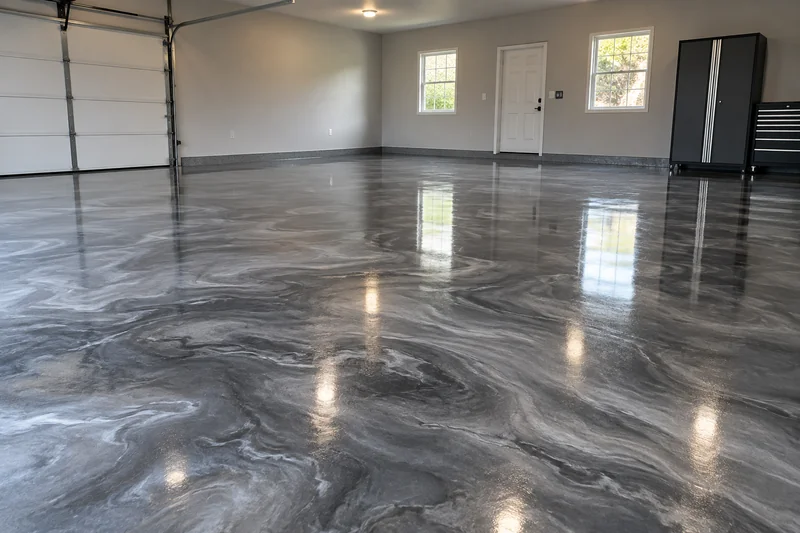
Gray metallic epoxy floor with a swirled finish

Metallic epoxy floors

Metallic epoxy floors suspend metallic pigments in the resin, which the installer moves by hand to create swirls and a three-dimensional depth. No two floors look the same. They're a favorite for showrooms, retail spaces, home gyms and showpiece garages, in tones from silver and charcoal to copper and deep blue.

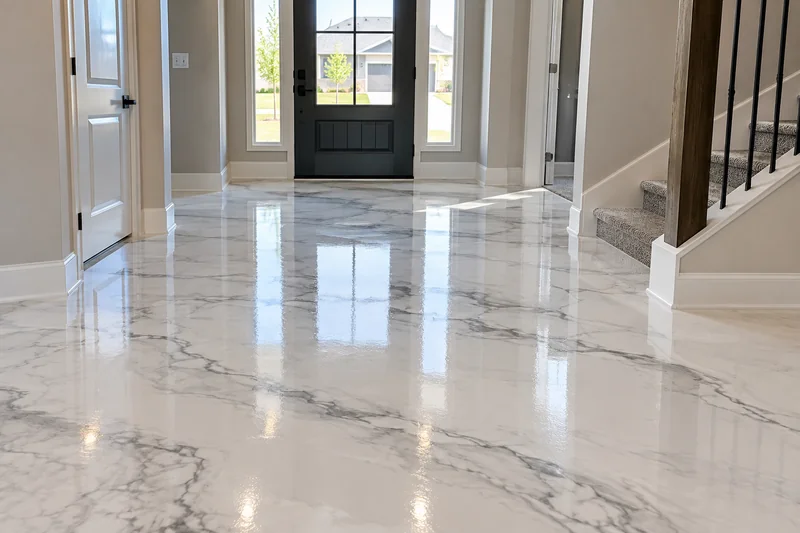
White marble-look epoxy floor in a home entryway

Marble-look epoxy floors

Marble epoxy floors layer pigments to create the veining of polished stone at a fraction of the cost and weight of real marble. Unlike marble, the epoxy version is seamless, won't etch from acidic spills and never needs resealing. It suits entryways, bathrooms and commercial lobbies.

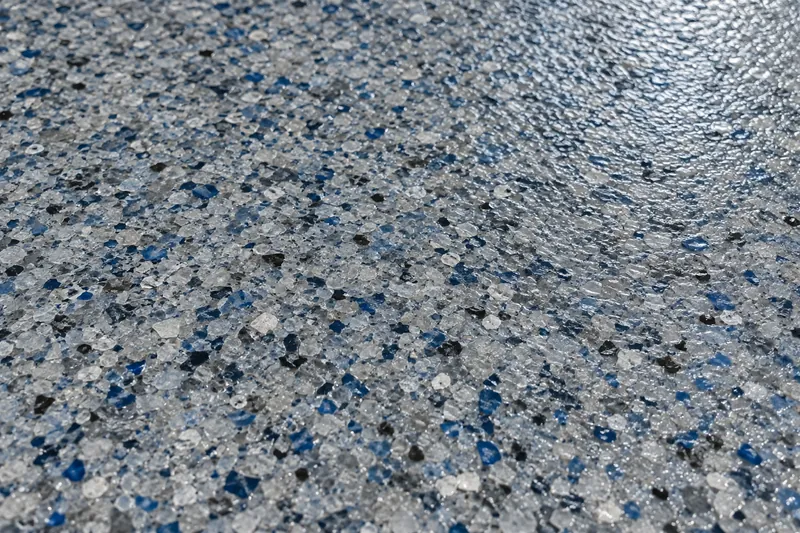
Close-up of a blue and gray quartz epoxy floor

Quartz epoxy floors

Quartz epoxy floors broadcast colored quartz granules between layers of epoxy for a textured, slip-resistant and wear-resistant surface. They're standard in commercial kitchens, locker rooms and other wet, frequently washed areas.

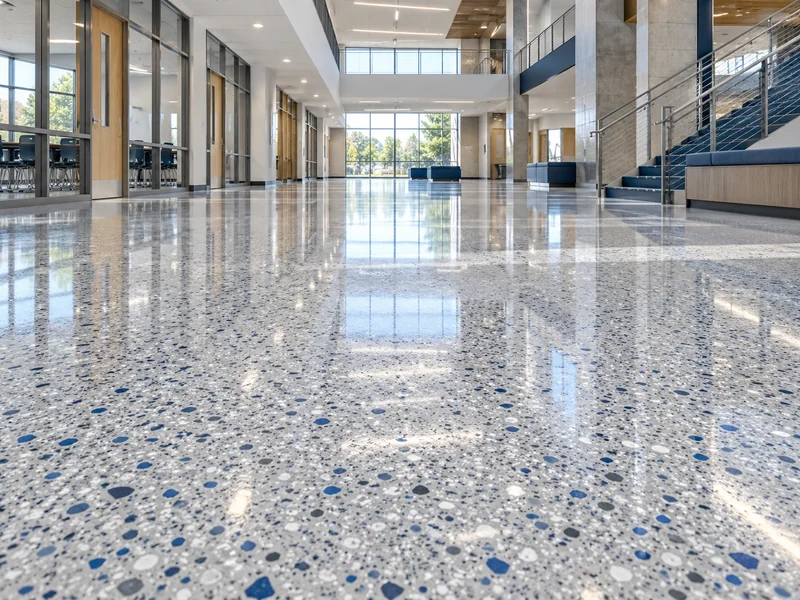
Polished epoxy terrazzo floor in a school hallway

Epoxy terrazzo flooring

Epoxy terrazzo sets marble, glass or quartz chips in an epoxy matrix, then grinds and polishes the surface smooth. It's thinner, lighter and faster to install than cement terrazzo, with a nearly unlimited color range, and it's common in schools, hospitals and retail spaces.

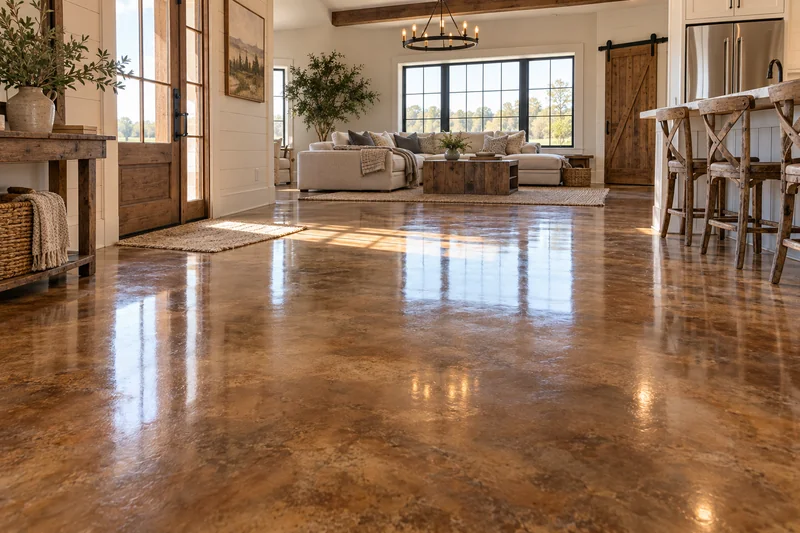
Clear epoxy coating over stained concrete in a living room

Solid color and clear epoxy coatings

Solid color epoxy gives a uniform finish in a single shade and is the most budget-friendly system for garages, utility rooms and warehouses. A clear epoxy floor coating protects stained, stamped or polished concrete without hiding it. Either can be finished in satin or gloss.

Residential epoxy flooring beyond the garage

Residential epoxy flooring works anywhere concrete needs a durable, easy-to-clean surface. We match the system to each space's sun, water and foot traffic.

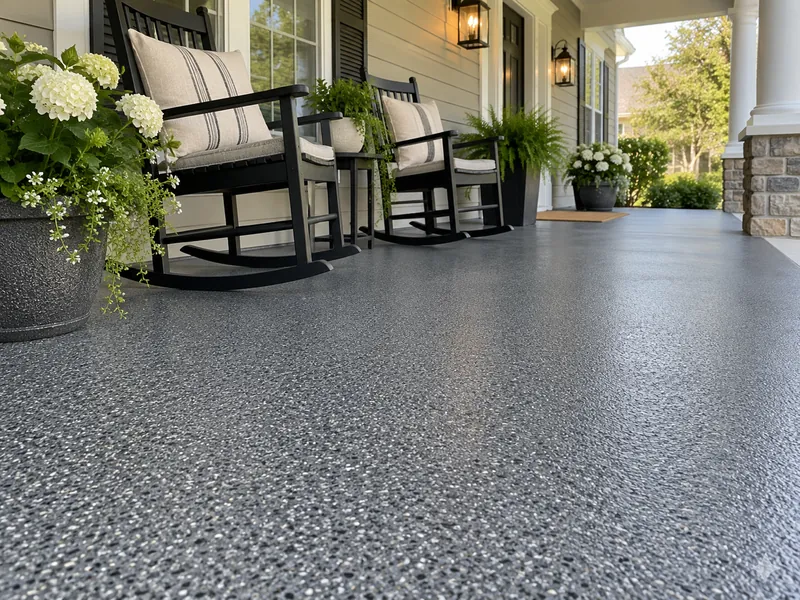
Slate gray epoxy coating on a covered front porch

Epoxy patio and porch coatings

Outdoor epoxy floors need a UV-stable topcoat, so patios and porches get a polyaspartic finish over the base coat. A broadcast aggregate adds grip around pool decks and covered porches, and the coating seals the slab against rain.

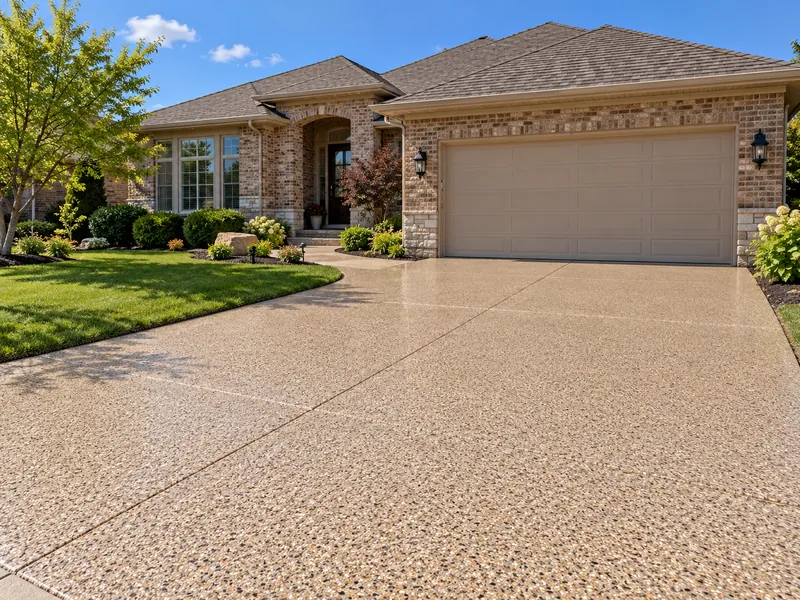
Flake-coated concrete driveway on a brick ranch home

Epoxy driveway coatings

Driveways face hot tires, oil, UV and freeze-thaw cycles all at once. An epoxy driveway system pairs a moisture-tolerant epoxy base with a flake or quartz broadcast and a UV-rated polyaspartic topcoat. Existing cracks are repaired and control joints are kept open so the coating moves with the slab.

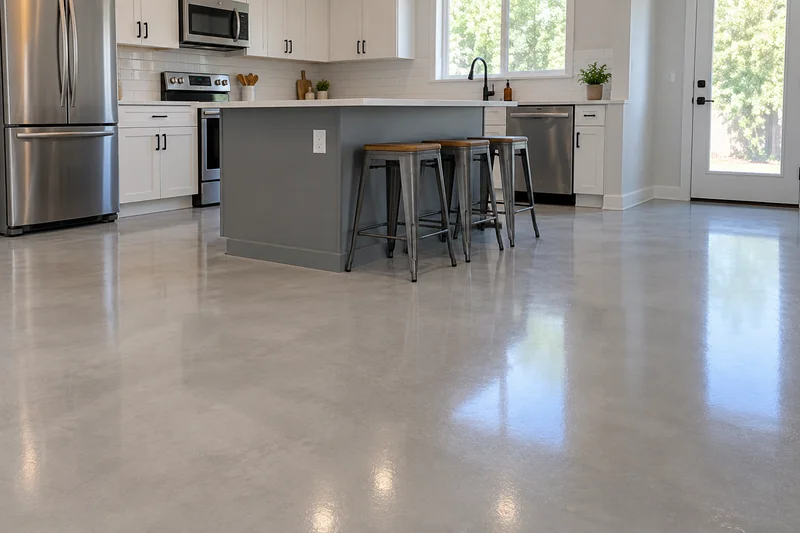
Seamless light gray epoxy floor in a modern kitchen

Epoxy kitchen floors

Epoxy kitchen floors are seamless and non-porous, so there are no grout lines to trap grease or spills. A slip-resistant additive in the topcoat keeps the floor safe when wet, and finishes range from neutral solids to flake blends and metallics.

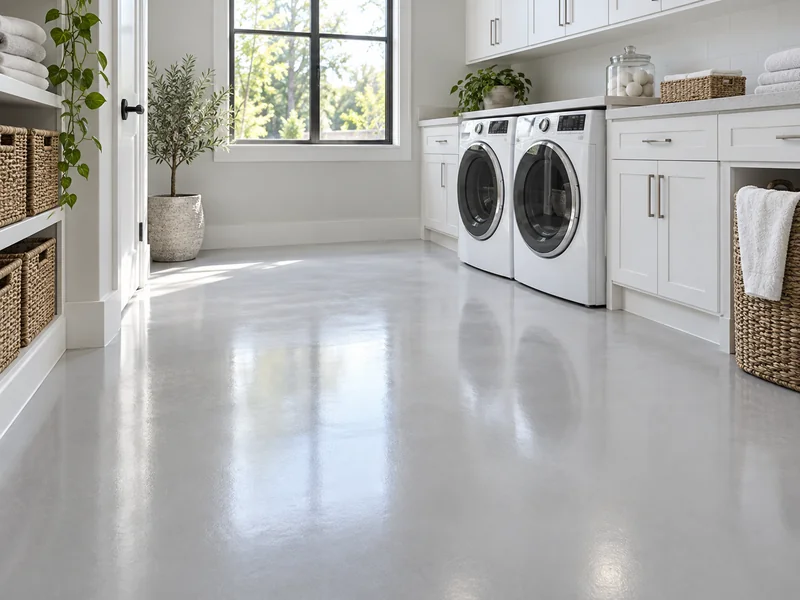
Seamless light gray epoxy floor in a laundry room

Epoxy bathroom and laundry room floors

Bathrooms and laundry rooms need a floor that holds up to water. We test the slab for moisture vapor first, since moisture under a coating causes bubbling and delamination. A sealed epoxy floor keeps a washer or water heater leak on the surface, and a textured topcoat cuts slip risk on wet floors.

Commercial and industrial epoxy flooring

Commercial epoxy flooring protects concrete from forklifts, chemicals and constant foot traffic. The right commercial floor coating depends on the loads, the chemicals and how often the floor is washed.

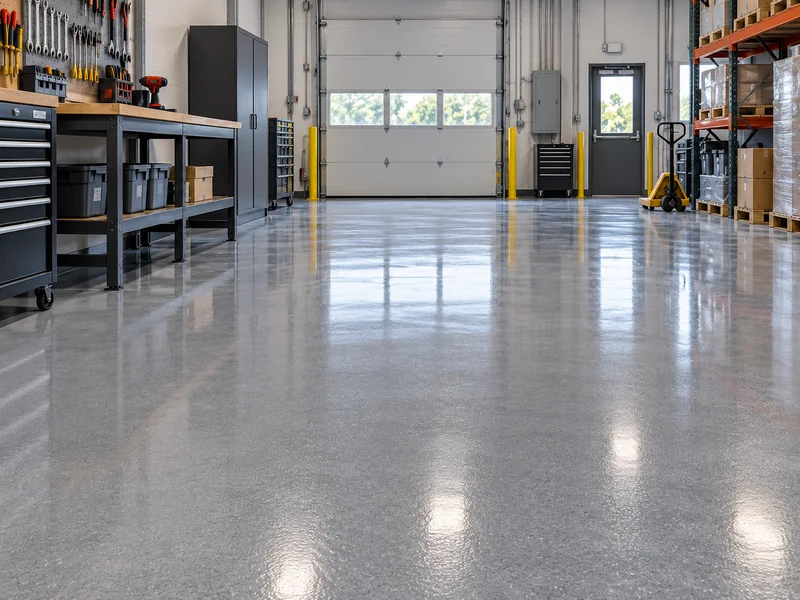
Gray industrial epoxy floor in a workshop with a workbench and pallet jack

Industrial epoxy flooring

Industrial epoxy flooring is built thicker than residential coatings to resist abrasion and impact from forklifts, machinery and dropped tools. Common industrial floor coatings include:

  • Novolac epoxy: for chemical and high-heat exposure
  • Quartz-filled systems: for slip resistance in wet areas
  • High-build epoxy: for constant equipment traffic
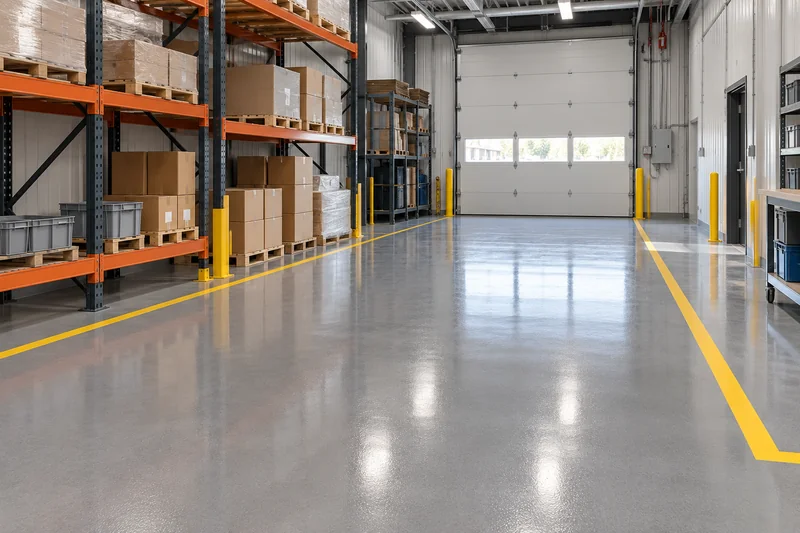
Warehouse epoxy floor with yellow safety striping

Warehouse floor coatings

Warehouse floor coatings seal dusty concrete, protect traffic lanes from pallet jacks and brighten the space by reflecting overhead light. Options include safety line striping, static-dissipative coatings for electronics storage and high-build epoxy in racking areas.

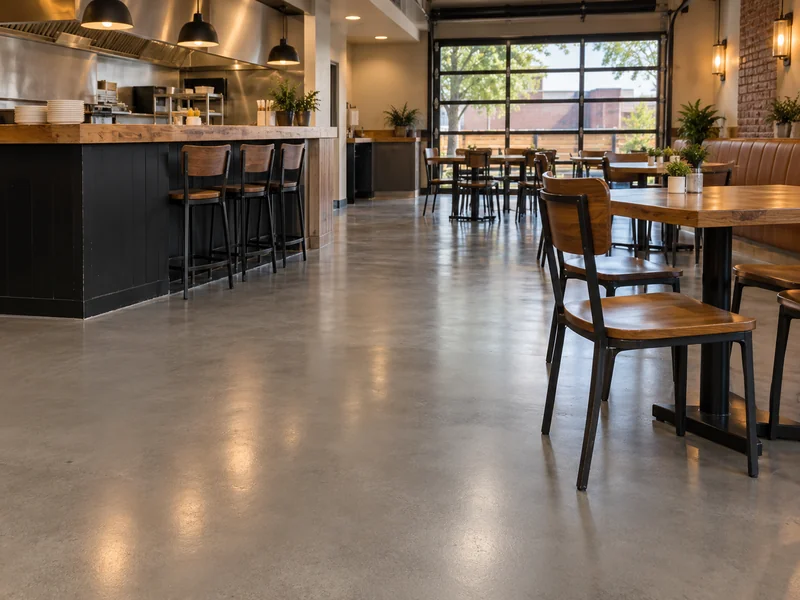
Seamless gray epoxy floor in a restaurant dining room

Restaurant and commercial kitchen epoxy flooring

Restaurant epoxy flooring replaces bacteria-trapping grout lines with one seamless surface that fits the FDA Food Code's call for smooth, durable, nonabsorbent and easily cleanable floors. Commercial kitchen epoxy flooring typically uses a quartz or urethane cement system with textured aggregate near cooking lines, chemical-resistant topcoats that stand up to sanitizers, and an integral cove base where the floor meets the wall.

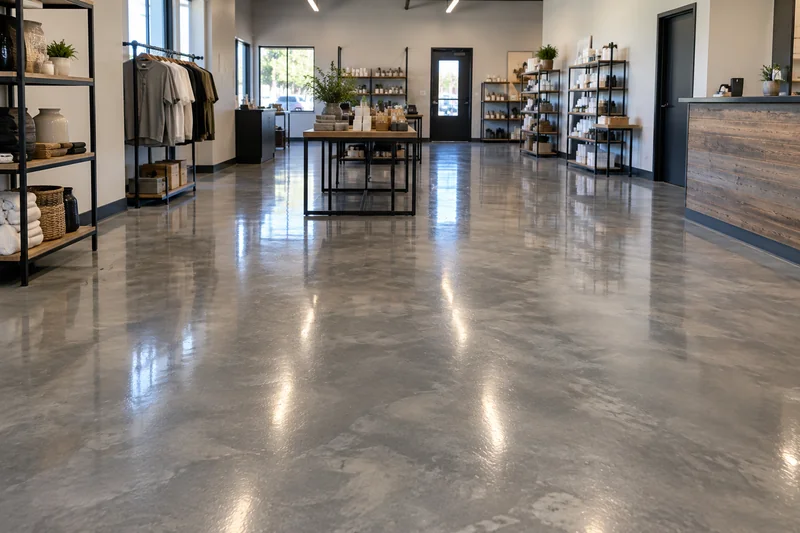
Gray epoxy floor in a retail boutique

Office and retail floor coatings

Customers and clients see office and retail floors every day, so appearance matters as much as durability. Lighter foot traffic also means a thinner, more economical system than an industrial floor.

FinishBest forWhy
Metallic epoxyShowrooms and lobbiesHigh-impact, one-of-a-kind look
Flake systemHigh-traffic retail floorsHides scuffs and dirt
Solid color epoxyOffices and back-of-house areasClean look at the lowest cost

Why we're the best epoxy flooring company in Edmond

Most coating failures come from poor prep, not bad product. Here's what every Edmond Epoxy Flooring job includes:

Diamond-ground prep

Every slab is ground to the right surface profile so the coating bonds.

Crack and spall repair

Fixed before coating, never covered up.

Moisture testing

Checked first to prevent bubbling and peeling.

Built for Oklahoma

Systems matched to expansive clay soils, 100-degree summers and freeze-thaw winters.

Fast-cure options

Polyaspartic floors are often finished in a single day.

Written estimates

Coating system, number of coats and finish spelled out up front.

Epoxy flooring cost in Edmond

Epoxy flooring in Edmond typically costs $3.50 to $8.50 per square foot installed, depending on the coating system, the slab's condition and the size of the floor.

How much does it cost to epoxy a garage floor?

A two-car garage in Edmond typically costs $1,400 to $5,900 to coat, depending on its size, the system you choose and how much repair the slab needs.

ProjectTypical sizeEstimated cost
1-car garageAbout 290 sq ft$1,000 – $3,000
2-car garage400 – 576 sq ft$1,400 – $5,900
3-car garageAbout 860 sq ft$3,000 – $8,800

Epoxy flooring cost per square foot

Expect about $3.50 to $8.50 per square foot. Solid color epoxy over a sound slab sits at the low end; flake, metallic and quartz finishes, extra coats and heavy prep push toward the top. Larger floors usually cost less per square foot.

Polyaspartic vs. epoxy cost

Polyaspartic floor coatings run about $4 to $10 per square foot in the Edmond area, roughly $1 to $2 more than epoxy. The premium buys one-day installation and UV stability. Many systems combine both, with an epoxy or polyurea base under a polyaspartic topcoat.

What affects the cost of an epoxy floor?

  • Surface prep: grinding, crack repair and moisture testing
  • Coating system: epoxy, polyaspartic or polyurea
  • Finish: solid color costs less than flake, metallic or quartz
  • Number of coats: multi-layer systems add material and labor
  • Square footage: larger floors lower the per-square-foot rate

Commercial epoxy flooring cost

Commercial epoxy flooring in Edmond generally runs $6 to $12 per square foot. Thicker industrial builds, chemical-resistant topcoats, slip-resistant aggregate and after-hours installation to avoid downtime push costs higher, while large open floors lower the per-foot rate.

Every quote spells out the coating system, the number of coats and the finish before any work starts — no guessing over the phone.

Get a free estimate

Proudly serving Edmond and nearby areas

Edmond Epoxy Flooring serves homeowners and businesses throughout Edmond, OK, from Downtown Edmond and the University of Central Oklahoma area to Oak Tree and the neighborhoods along Covell Road and Coffee Creek Road. We also serve Oklahoma City, Arcadia, Jones, Luther, Guthrie, Deer Creek, Nichols Hills, The Village and Piedmont.

FAQs

How is an epoxy floor installed?

The slab is diamond ground to open its surface, then cracks and spalls are repaired and the concrete is tested for moisture. Next comes a base coat, an optional flake, quartz or metallic layer, and a clear topcoat. Most residential floors are finished in one to two days.

How long does it take to epoxy a garage floor?

Most garage floors take one to two days with epoxy, and polyaspartic systems can often be done in a single day. Floors that need extensive crack repair or resurfacing may take an extra day.

How soon can I walk and park on a new epoxy floor?

With epoxy, light foot traffic is usually fine after 24 hours and vehicles after about 72 hours, with a full cure in about seven days. Polyaspartic floors typically allow foot traffic within a few hours and parking within 24 to 48 hours.

How long does an epoxy floor last?

A professionally installed 100% solids epoxy floor typically lasts 10 to 20 years, compared with 3 to 5 years for water-based DIY kits. Prep, coating thickness and traffic all affect lifespan, and a worn floor can be ground and recoated.

Which floor coating systems do you install?

We install 100% solids epoxy, polyaspartic and polyurea systems, finished in flake, metallic, quartz or solid color and sealed with a polyaspartic or urethane topcoat. Epoxy is the thick, budget-friendly base; polyaspartic cures in hours and resists UV yellowing; polyurea adds flexibility for impacts and slab movement.

Is polyaspartic better than epoxy?

No, not in every case. Polyaspartic cures faster, resists UV yellowing and handles temperature swings better, which makes it the stronger choice for sunny garages and outdoor concrete. Epoxy costs less and builds a thicker coat, so it's still a good fit for indoor floors and as a base under a polyaspartic topcoat.

What is the difference between polyurea and epoxy?

Polyurea is flexible, cures in hours and resists UV, while epoxy is rigid, cures over several days and yellows in sunlight. Polyurea is usually a base coat in fast-cure garage systems; epoxy costs less and is common on indoor and commercial floors.

Is garage floor paint the same as an epoxy coating?

No. Garage floor paint, including one-part epoxy paint, is a thin film that sits on the surface and often peels within a year or two. A professional epoxy coating is a thicker two-part system bonded to ground concrete.

Are epoxy floors slippery?

No, not with a slip-resistant additive. Smooth, high-gloss epoxy can be slick when wet, so we add aggregate to the topcoat in garages, kitchens, bathrooms and outdoor areas. Flake and quartz finishes add texture on their own.

Can you apply epoxy over cracked concrete?

Yes, once the cracks are repaired. Cracks are filled with epoxy or polyurea filler and ground flush before coating. Cracks that are actively moving or heaving may need concrete repair first.

What is the best garage floor coating?

For most Edmond garages, the best garage floor coating is a flake system with an epoxy or polyurea base and a polyaspartic topcoat, which balances durability, UV resistance and fast turnaround. A straight epoxy system is the budget choice for garages out of direct sun.

Is an epoxy garage floor worth it?

Yes, for most homeowners. An epoxy garage floor stops concrete dusting and oil stains, cleans up with a mop, brightens the space and protects the slab for years.

Does an epoxy floor hold up to Oklahoma heat and cold?

Yes, when the system fits the conditions. Polyaspartic and polyurea topcoats handle UV and temperature swings better than straight epoxy, and a sealed slab keeps out the water that causes freeze-thaw damage.

Ready to coat your floor?

Tell us about your garage, patio or commercial floor and we'll put the coating system, number of coats and finish in writing before any work starts.